
Correct horse hoof angle: understanding and improving low/negative palmar/plantar angles (NPA)
Correct hoof angles are an important foundation for soundness, yet it’s one of the most misunderstood topics in hoof care. You may have heard the abbreviation NPA, which stands for either negative palmar angle (if in the front feet) or negative plantar angle (if in the hind feet) - both describe a hoof shape that compromises healthy biomechanics.
This blog will explain what NPA is, what causes it, why shoes with wedge pads aren’t the quick fix many people think they are, and how to truly help your horse develop correct hoof angles through trimming, diet, movement, and hoof protection.

What is a correct horse hoof angle?
In a healthy hoof, the pedal bone (P3) should sit at a slight positive angle, meaning that the front tip of the bone is slightly lower than the back of the bone. This ensures straight alignment of the bones in the horse’s lower limb and allows efficient weight-bearing. The exact degree of this angle can vary; some horses have 5 degrees, others closer to 8 degrees. What matters is that the internal alignment is correct for that individual horse.
The structure that holds the pedal bone at its correct angle, is the digital cushion (yellow part in the drawing below). People fixate on the heels - the part that we trim - but it's important to understand the heels are not the problem, it's the digital cushion that is in trouble. Therefore, leaving the heels untrimmed in order to correct poor hoof angles, is the wrong way to go about the problem!

A negative palmar angle (front feet) or negative plantar angle (hind feet) means the rear part of P3 (pedal bone) is sitting lower than the front. In other words, the angle is tipped backwards, placing unnatural stress on the hoof capsule and internal structures.
Here are a few examples of different hoof angles. The first image shows the low hoof of a high–low–footed Thoroughbred. The middle one belongs to a yearling, and the final example is from a Draft/Arab/Paint cross. Each hoof is healthy and sound. Notice how the hoof walls appear even and largely free of "event lines".

The next photo shows the classic negative palmar angle appearance; low heels or rather caudal hoof, and a bull-nosed dorsal hoof wall. It’s a Thoroughbred recently out of shoes. Note the event lines on the hoof wall indicating ongoing inflammation. It's worth noting that this horse has lumbar arthritis and sacroiliac injury.

What causes a negative palmar or plantar angle?
Several factors contribute to NPA and incorrect horse hoof angles. The most common include:
1. Weak or damaged digital cushion
The digital cushion starts as fatty tissue at birth and should strengthen into firm fibrocartilage with movement. Lack of correct movement in young horses - or early shoeing that prevents natural hoof function - leads to weak digital cushions and low, collapsed heels. The digital cushion is what is inside the heel bulbs of your horse's hoof!
2. Poor diet and inflammation
A diet too rich in sugars weakens hoof horn and the laminae and creates a constant state of low-grade laminitis. Without strong hoof horn and laminae, the heels can’t “stand up” in the correct orientation.
3. Shoeing
Shoes create peripheral loading and prevent the digital cushion from functioning correctly. This often leads to contracted heels and soft tissue atrophy. Horses shod at a young age are especially at risk.
4. Upper body problems
Back pain, sacroiliac issues, or stifle problems alter how the hoof is loaded. Since the hoof adapts to pressure, these issues can create or worsen NPA, since the hoof is highly malleable and will adapt to the pressures placed on it.
How to improve a negative palmar angle (NPA)
Many professionals recommend shoes with wedge pads. But these only mask the problem; they don't strengthen the digital cushion, rather the horse is propped up on an artificial orthotic. X-rays may show increased sole depth but once the horse is out of shoes, most of the time this sole simply exfoliates away since it was compacted "dead" sole, rather than thicker "live" sole. Often, the hooves are in worse shape than when the procedure was started.
Here’s an alternative that works with the horse's biology:
1. Frequent, correct trimming
Back the heels and toes weekly to maintain correct form. Trimming every 4–8 weeks is too infrequent to allow proper recovery.
2. Improve the diet
Remove excess sugars (grass), and provide balanced nutrition. Without this, laminae can’t tighten, soles can’t gain depth, and correct hoof angles won’t be restored. Horses who struggle with hoof angles will collapse in a matter of a few weeks if their diet causes inflammation- you cannot be too careful here!
3. Use hoof boots and pads
Hoof boots that are soft enough, used with cushioning pads inside them, support heel-first landings. This stimulates the digital cushion, encouraging it to strengthen over time. Use them as much and for as long as needed, and always for exercise.
4. Encourage movement
Quality movement increases circulation and helps rebuild internal hoof structures. 24/7 turnout and correct training are vital. Track systems, even simple ones are the best way to eliminate grass and keep the horse on the move if the hay is spread around the track.
5. Address body issues
Chiropractic, bodywork, correct saddle fit, and correct training are all part of the bigger picture. If the body is unbalanced or injured, the hooves will be too. If the problem originates from the spine, then you will not be able to correct it by only working on the hooves.
Here's a photo collage of a hoof belonging to a high level eventing horse with a prolapsed frog and very little sole depth. The middle photo is around 2 weeks post shoe removal, and the last photo another 6-8 weeks after that. This horse was trimmed weekly by his owner, and every 4 weeks by a professional, as well as removed from grass. Previously he would trip a lot but that stopped immediately after removing the shoes and using soft, cushioning hoof boots.

Why wedge pads don’t solve NPA
Wedges can temporarily alter angles but they don’t rebuild the digital cushion or fix the underlying issues. Using them inconsistently inside hoof boots (e.g. only when riding) is completely counter intuitive; the horse is propped up on an orthotic sometimes but not at other times.
Instead of relying on wedges, it makes more sense to focus on:
A proper, short trim cycle
Diet changes
Movement and circulation
Correct hoof protection with pads and boots
Realistic expectations for recovery
Correcting a negative palmar/plantar angle takes time. Some horses improve quickly; others take months or years, especially if digital cushion damage is severe. Even in advanced cases, improvement is almost always possible, and many horses go on to live sound, active lives.
The key is consistency: diet, trimming, hoof protection, movement, and training all need to work together.
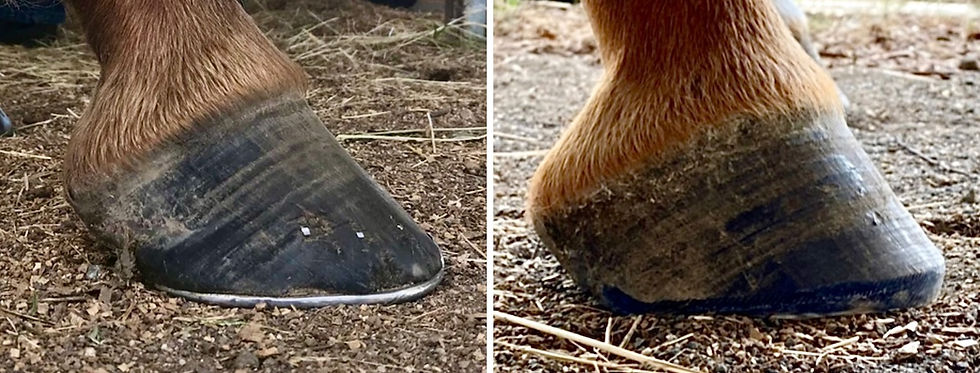
Here's an example of a hoof that went from extremely unhealthy hoof angles, to a big improvement within approximately 9 months.
Fitting hoof boots for horses with NPA
Horses with negative palmar or plantar angles often benefit from hoof boots during rehab. If possible, stay away from rigid, hard plastic boots and opt for softer, more flexible hoof boots instead. In any case, add soft, cushioning pads into the boots to ensure your horse's comfort.
When fitting boots for horses with NPA, there are a few key things to keep in mind:
If the hoof wall is bull-nosed, correct trimming must come first. A bull nosed toe is too high - it's a trimming issue.
Boots should fit correctly; poor fit can cause rubbing.
Sometimes, weekly trimming is needed to maintain sufficient hoof form for boot fit during rehab.
When boots are fitted properly and combined with trimming and diet, they are a powerful tool for restoring correct horse hoof angle.
Final thoughts: achieving better hoof angles
Fixing NPA isn’t about gimmicks or quick fixes. It’s about going back to basics to allow the hoof to heal and develop:
Trim correctly and often
Feed appropriately
Encourage natural movement
Use boots and pads for support when needed, and always for exercise
Address body and training issues
Do this consistently, and the hoof will adapt, strengthen, and grow into its correct form.
Even severely damaged feet can improve, sometimes dramatically. The process may take time, but the reward is a horse that is sound, comfortable, and able to live and work happily barefoot.
Do you want to get to the bottom of what's causing your horse's hoof problems, and learn how to fix them for good? Join our Hoof Care Essentials online course, and you will learn all this and much more!


